Why do pufferfish puff up? (And can they breathe while they do?)
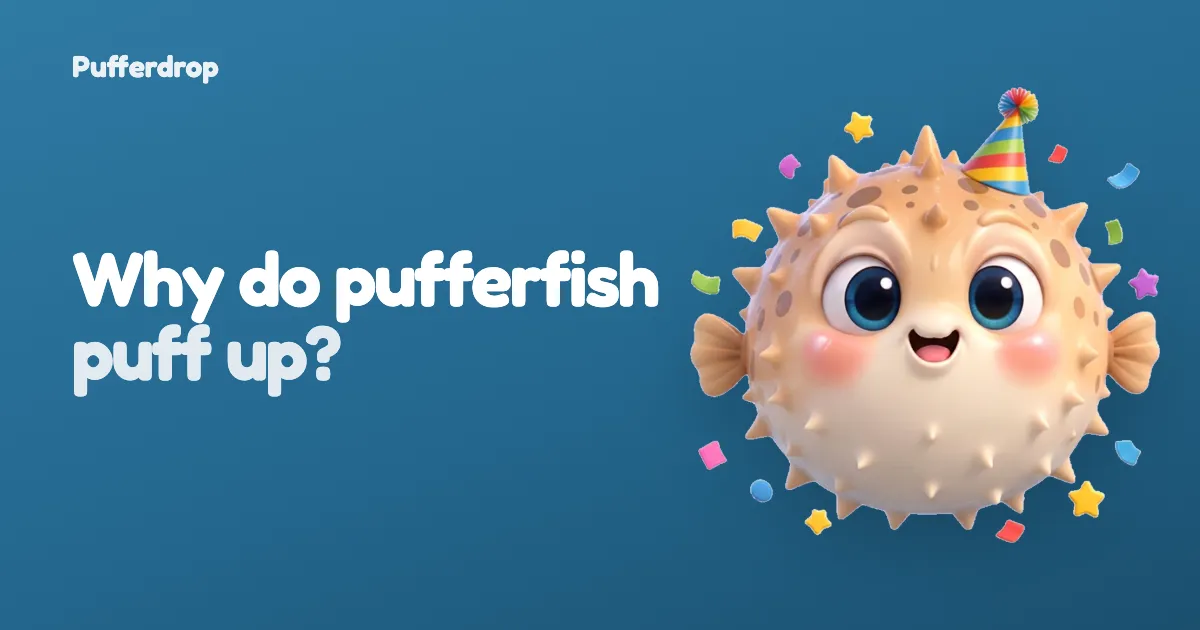
Pufferfish puff up to defend themselves. When something threatens them, they rapidly gulp water into a very stretchy stomach and swell into a spiky ball three to four times their resting size, which is much harder for a predator to swallow.
Our app’s fish puffs up for a gentler reason (you drank some water), so we went and read what real pufferfish actually do.
How do pufferfish puff up?
They pump water. Researchers describe the inflation as “rapid gulping of water into a distensible stomach”, which stretches their unusually elastic skin and makes small spines in it stand up (McGee & Clark, 2014). The mouth and throat work as a pump, drawing water in and pushing it down into the stomach in a series of gulps.
In the balloonfish, a pufferfish relative, the stomach is so specialised for this that it is highly extensible and no longer works as a digestive organ (Brainerd, 1994). A 2026 study, still a preprint that hasn’t been peer reviewed, counted about 29 gulps over about 9 seconds for the fish it filmed to fill up completely (bioRxiv).
How big can a pufferfish get?
The finished ball “can be three- to four-times the resting volume of the fish” (McGee & Clark, 2014). Volume grows faster than length, so the fish doesn’t look four times longer; it looks like a ball.
Can a pufferfish breathe while it’s puffed up?
Yes. For a long time the idea was that pufferfish hold their breath while inflated and lean on breathing through their skin. When researchers measured it in the black-saddled pufferfish, they found the opposite: the fish kept taking up oxygen through its gills, at about five times its resting rate, and barely used its skin at all. In their trials the fish stayed inflated for between 3.7 and 18 minutes (McGee & Clark, 2014).
Does puffing up hurt a pufferfish?
It’s costly. In the same study, the fish took an average of 5.6 hours to get their metabolism back to resting levels after deflating (McGee & Clark, 2014). Puffing up is an emergency defence, not something a pufferfish does for fun, so it’s not something to provoke for a photo.
Why are pufferfish poisonous?
Pufferfish accumulate a nerve toxin called tetrodotoxin in their bodies (Ahn et al., 2018), and McGee and Clark describe the toxin in pufferfish flesh as “one of the most potent toxins known to science”. So a predator faces two defences: a spiky ball that’s hard to swallow, and a meal that’s dangerous to eat.
So why does Pufferdrop’s fish puff up?
Because that’s what water does to a pufferfish. In the app, a cartoon pufferfish lives in a glass bowl that fills with every drink you log. It starts the day flat on the floor of the bowl, half puffs as you get going, and becomes a perfect spiky ball when you reach your daily goal. Unlike the real thing, it puffs up because you drank, not because something scared it, and it never needs 5.6 hours to recover.
If you’re curious how that bowl fills without opening the app, here’s every way to log a drink from your iPhone and Apple Watch.